
Fishing in New Caledonia offers anglers access to the world’s largest enclosed lagoon, teeming with Giant Trevally, Bonefish, and Coral Trout, alongside deep-sea opportunities for Marlin and Tuna. Just a short flight from Auckland, this French territory combines pristine marine reserves with strict conservation regulations, making it a premier sustainable sportfishing destination for Kiwi enthusiasts.
Why New Caledonia is a World-Class Fishery
For New Zealand anglers accustomed to the cold waters of the Hauraki Gulf or the intricate fly fishing of the South Island, New Caledonia represents the ultimate tropical upgrade just three hours north of Auckland. This French Pacific territory is not merely another island destination; it is home to a UNESCO World Heritage-listed lagoon that encompasses over 24,000 square kilometers of reef systems. This biodiversity hotspot creates a unique ecosystem where pelagic monsters meet reef dwellers in crystal clear shallow waters.
The primary draw for the international fishing community is the sheer variety of environments available. Unlike many Pacific destinations that specialize in just one style of fishing, New Caledonia offers a trifecta: expansive flats for fly fishing, jagged reef edges for heavy tackle popping, and deep trenches for blue water trolling. The infrastructure is distinctly French-Melanesian, meaning high-quality service, excellent cuisine, and well-maintained charter vessels are the norm rather than the exception.
Furthermore, the fishing pressure in New Caledonia is significantly lower than in destinations like Fiji or Rarotonga. Vast swathes of the northern lagoon and the remote Loyalty Islands see very few lines in the water annually. This lack of pressure results in fish that are less “spooky” and more aggressive, providing sport that harkens back to how the Pacific was decades ago. For the Kiwi angler, it is the closest opportunity to target the legendary Giant Trevally (GT) on topwater lures without enduring long-haul flights to the Seychelles or Christmas Island.

The Lagoon vs The Deep Sea
Understanding the geography of New Caledonia is essential for planning a successful expedition. The fishery is distinctly divided into two zones: the inner lagoon (including the flats and fringing reefs) and the outer reef (blue water). Each requires different tactics, gear, and expectations.
Inside the Lagoon: The Flats and Reef Edges
The lagoon is the heart of New Caledonia’s fishing fame. It is here that the “Grand Lagon Sud” (Great Southern Lagoon) provides vast flats that are arguably some of the best in the world for sight fishing.
- Target Species: The undisputed king here is the Giant Trevally (GT). These fish patrol the reef edges and can often be found cruising the flats in search of prey. Alongside GTs, anglers can target Bluefin Trevally, Red Bass, Coral Trout, and the elusive Bonefish. The Bonefish here are generally larger than their Caribbean cousins, often averaging 6-8lbs, though they are found in deeper water and are more challenging to spot.
- Techniques: For spin anglers, heavy popping and stick baits are the name of the game. Casting large surface lures near coral heads induces explosive strikes. For fly anglers, a 10wt or 12wt setup is standard. Stalking the flats requires patience and polarized sunglasses, as you will be sight-casting to cruising fish.
The Blue Water: Beyond the Barrier
Once you exit the passes of the barrier reef, the ocean floor drops away dramatically. New Caledonia’s underwater topography features seamounts and trenches that act as highways for migratory pelagics.
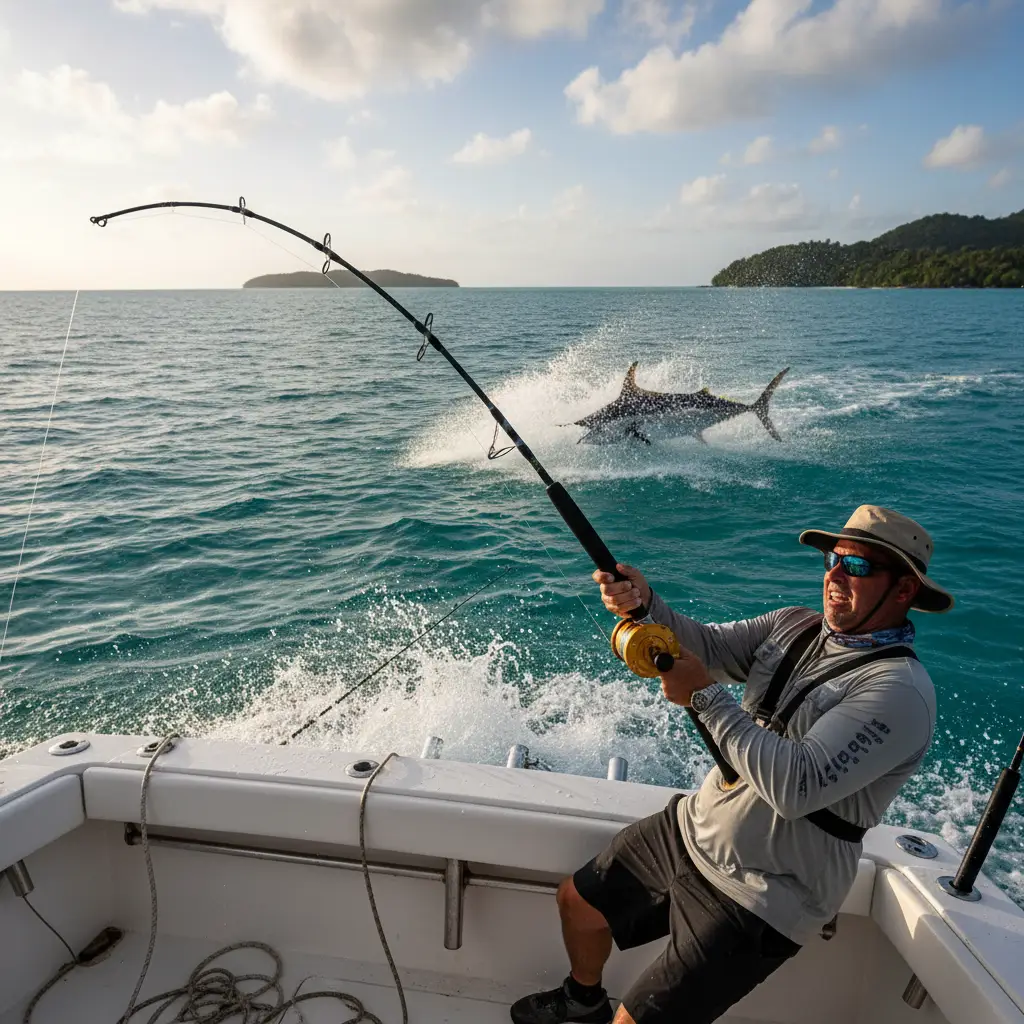
- Target Species: Black and Blue Marlin are present year-round, though the seasons peak at different times. Yellowfin Tuna, Wahoo, Spanish Mackerel, and Mahi Mahi are abundant. The Dogtooth Tuna, a bucket-list fish for many, haunts the deep drop-offs and presents one of the toughest fights in the ocean.
- Techniques: Trolling lures and dead baits is the standard method for Marlin and Mahi Mahi. However, mechanical jigging has exploded in popularity. Dropping heavy jigs (200g-400g) over seamounts is the most effective way to target Dogtooth Tuna and deep-water Grouper.
Seasonal Fishing Calendar
While you can fish year-round, aligning your trip with the migration patterns of your target species is crucial for success.
Summer (December to March)
This is the peak season for pelagics. The water is warmest (around 26°C – 29°C), bringing the large Blue Marlin and Yellowfin Tuna closer to the reef. It is also the cyclone season, so travel insurance and flexible booking are recommended. For flats fishing, the warm water makes the fish active, but the midday heat can be intense.
Winter (June to September)
The “cooler” months (water temps around 22°C) are often preferred by GT anglers. The cooler water allows big GTs to come up onto the shallow flats more frequently without overheating. Wahoo and Spanish Mackerel congregate in large numbers during this time. The trade winds can be stronger in these months, so looking for charters that fish the leeward side of the main island (Grande Terre) is a smart strategic move.
Regulations and Catch & Release Ethics
New Caledonia takes marine conservation seriously. As a visitor, it is imperative to respect local laws and the cultural significance of the ocean to the Kanak people.
Protected Species and Zones
Strict regulations govern specific species. Sharks of all species are protected in New Caledonia; it is illegal to target, harm, or keep them. If you accidentally hook a shark, it must be released immediately with minimal harm—cut the leader if necessary. Napoleon Wrasse, Dugongs, and Sea Turtles are also strictly protected.
There are numerous Marine Protected Areas (MPAs) where fishing is entirely prohibited. These are often marked on charts, but relying on a licensed local skipper is the best way to ensure compliance. The “Yves Merlet” reserve, for example, is a complete no-take zone.
Ciguatera Awareness
A critical note for Kiwi anglers who love a fish fry: Ciguatera poisoning is a risk in New Caledonia, particularly with large reef fish. The toxin accumulates in predators like Barracuda, large Groupers, and sometimes large Trevally. Local knowledge is vital here. Most charter operators enforce a strict Catch and Release policy for reef species to preserve the stock and ensure guest safety. Pelagic fish like Tuna, Wahoo, and Mahi Mahi are generally safe and delicious.
The Catch and Release Culture
Sportfishing in New Caledonia is heavily oriented toward Catch and Release, particularly for GTs and Dogtooth Tuna. Anglers are expected to use barbless hooks (or crushed barbs) to facilitate easy release. When handling a GT for a photo, never hang the fish vertically by the jaw, as this damages their internal organs. Always support the belly horizontally and keep the fish in the water as much as possible.

Bringing Gear into New Caledonia: Customs Rules
Traveling with fishing gear requires preparation. New Zealand has some of the strictest biosecurity in the world, but New Caledonia also has rules to protect its ecosystem.
Customs and Biosecurity
When entering New Caledonia (usually via La Tontouta International Airport), you generally do not need a specific permit to bring sport fishing gear for personal use. However, all gear must be clean and dry. While New Caledonia does not have Didymo, they are wary of invasive algae and pests. Ensure your waders (if bringing them, though wet wading is preferred), boots, and lines are free of organic matter.
Airline Allowances
Most Kiwi anglers fly with Aircalin or Air New Zealand.
Aircalin: They are generally very accommodating to sports equipment. They often have a specific allowance for fishing rod tubes (Sporting Equipment allowance), but you must book this in advance. Rod tubes should be hard-case PVC or Bazooka style.
Air New Zealand: Standard baggage rules usually apply, meaning a rod tube counts as one piece of checked luggage. Ensure your tube length does not exceed the maximum dimension (usually 2m) for standard haulage, or it will go as cargo.
Recommended Gear Checklist
Do not rely on buying high-end tackle in Nouméa; while there are shops, stock can be limited and prices are high due to import taxes. Bring what you need.
- GT Setup: PE8-10 rod, 18000-20000 size reel, 100lb braid, 170lb shock leader.
- Light Spin/Reef: PE3-5 rod, 5000-8000 size reel, for Bluefin Trevally and Coral Trout.
- Fly Gear: 9ft 10wt or 12wt rod. Tropical floating lines are essential (cold water lines will turn to noodle in the heat).
- Lures: Stickbaits (floating and sinking), large poppers, and metal jigs (200g+). Replace all trebles with high-quality inline single hooks to prevent fish damage and increase safety for the angler.

Frequently Asked Questions
Do I need a fishing license in New Caledonia?
Generally, for recreational fishing from a boat or shore, a personal license is not required for tourists. However, strict regulations apply to marine reserves and protected species. If you are fishing specifically in the Southern Province on a private boat, rules can vary, but if you are booking with a licensed charter captain, they cover all necessary permitting.
Is it safe to eat the fish I catch?
Pelagic fish like Yellowfin Tuna, Mahi Mahi, and Wahoo are safe and delicious. However, reef fish (Grouper, Barracuda, Snapper, Trevally) carry a high risk of Ciguatera poisoning. It is strongly advised to release all reef fish and only consume pelagics vetted by your skipper.
What is the best currency to use for charters?
The local currency is the Pacific Franc (XPF). While some major operators may accept Credit Cards, smaller guides often prefer cash. It is best to exchange money at the airport or withdraw from ATMs in Nouméa. Do not expect to use New Zealand Dollars (NZD) directly.
Can I fly fish from the shore without a boat?
Yes, there are accessible flats, particularly around the main island (Grande Terre) and the Isle of Pines. However, accessing the prime, unpressured flats usually requires a boat transfer to the outer islands or barrier reef. Shore-based fishing near populated areas like Nouméa is often overfished.
Are there dangerous animals to be aware of?
Yes. Apart from sharks (which should be respected), be wary of Sea Snakes (Tricot Rayé), Stonefish, and Cone Snails in the lagoon. Always wear reef booties when wading to protect against stonefish spines and sharp coral.
How much does a fishing charter cost in New Caledonia?
Prices vary, but expect to pay between 80,000 to 150,000 XPF (approx. $1,100 – $2,100 NZD) per day for a full boat charter. High-end multi-day liveaboard expeditions to remote atolls will cost significantly more.