
Bougna is the traditional festive dish of the Kanak people in New Caledonia, symbolizing a profound connection to the land. It consists of starch staples like taro and yams, combined with chicken, fish, or lobster, and soaked in coconut milk. These ingredients are wrapped in banana leaves and slow-cooked over hot stones in a buried earth oven.
What is Bougna? Understanding the Soul of Kanak Cuisine
For travelers venturing from New Zealand to the pristine shores of New Caledonia, the culinary landscape offers a distinct fusion of French sophistication and Melanesian tradition. However, to truly understand the heartbeat of this archipelago, one must look beyond the croissants and pâté to the Bougna. This is not merely a meal; it is an institution, a ritual, and the centerpiece of Kanak social life.
The term “Bougna” is derived from the Drehu language (spoken on Lifou Island) word “puhnya,” which roughly translates to “bundle” or “pack.” This etymology perfectly describes the dish’s physical form: a tightly wrapped parcel of banana leaves containing a treasure trove of local produce. Unlike Western cooking, where ingredients are often cooked separately and assembled, the Bougna relies on the alchemy of communal cooking. The flavors meld together in a hermetically sealed environment, creating a taste profile that is earthy, smoky, and rich with the sweetness of coconut.
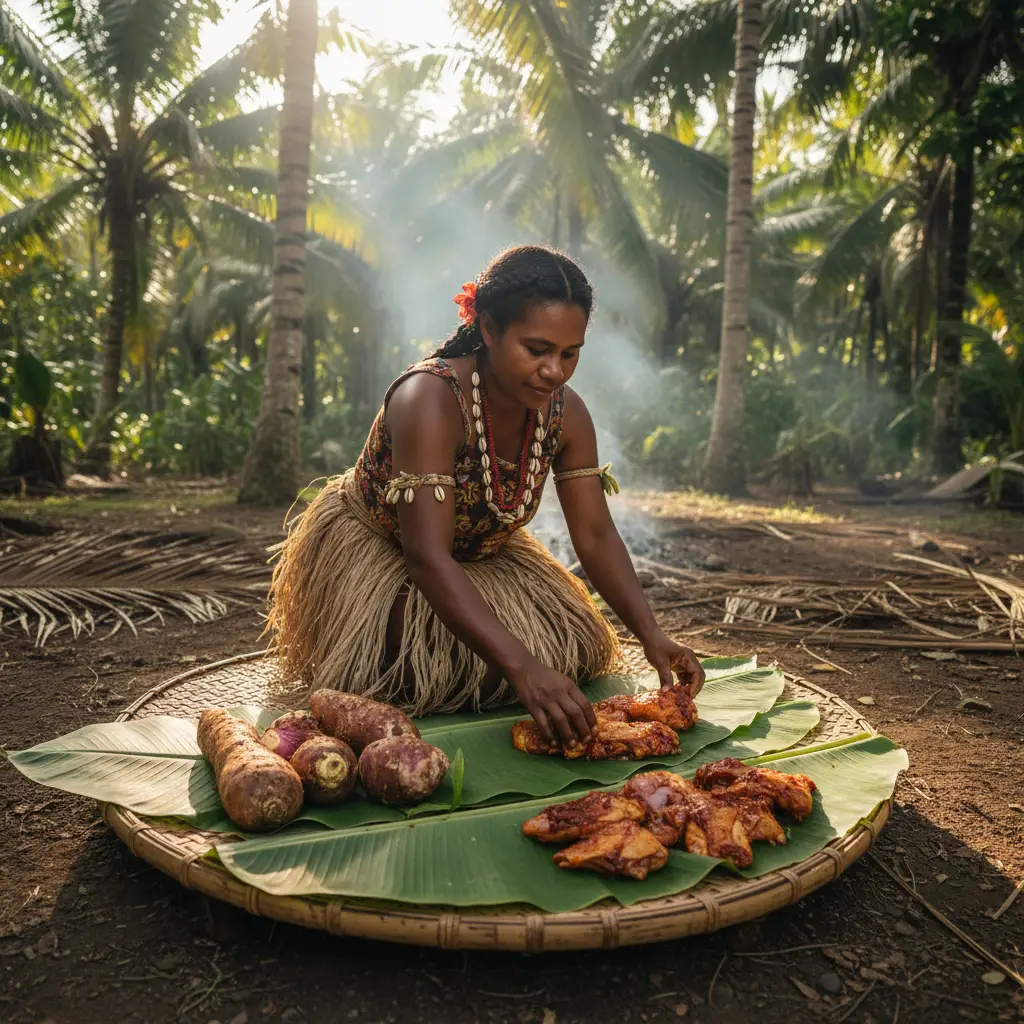
In Kanak culture, the preparation of Bougna is often reserved for special occasions—weddings, customary ceremonies, or welcoming honored guests. For the Kiwi traveler, partaking in a Bougna feast is akin to experiencing a Hāngī; it is a communal event that honors the earth and the people gathering around it. The dish represents the “Custom” (La Coutume), the code of conduct and social hierarchy that governs Kanak society. The yams used often symbolize male virility and chieftainship, while the preparation process involves the entire family or tribe.
Deconstructing the Ingredients: Yams, Taro, and Coconut Milk
The beauty of a Bougna lies in its simplicity and reliance on fresh, locally sourced ingredients. There are no preservatives or artificial flavor enhancers here; the flavor comes from the quality of the produce and the smoke of the oven. While variations exist depending on the region (Grande Terre vs. the Loyalty Islands) and the catch of the day, the core components remain consistent.
The Tubers: The Foundation
At the heart of every Bougna are the sacred tubers. These root vegetables provide the starch and texture necessary to absorb the coconut milk.
- Yams (Ignames): The most culturally significant crop in Kanak society. They offer a dry, starchy texture that holds up well during the long cooking process.
- Taro: Known for its slightly nutty flavor and purple-speckled white flesh. Taro becomes incredibly creamy when slow-cooked.
- Manioc (Cassava): Often added for variety, manioc brings a chewy, dense texture to the mix.
- Sweet Potato (Kumara): Familiar to New Zealanders, the local varieties add a necessary sweetness to balance the savory elements.
The Protein: Land and Sea
The protein source dictates the character of the Bougna. The most common traditional version uses chicken, often free-range village fowls that have a stronger flavor than commercial poultry. However, coastal tribes frequently utilize the bounty of the lagoon.
Fish Bougna usually features firm-fleshed reef fish like parrotfish or snapper, which steam gently in the leaves. For a truly luxurious experience, Lobster Bougna (Bougna aux Langoustes) is the pinnacle of New Caledonian gastronomy, where the sweet meat of the lobster infuses the coconut milk with a rich seafood stock.
The Binding Agent: Coconut Milk
No Bougna is complete without fresh coconut milk. This is not the canned variety found in supermarkets. The coconut flesh is grated by hand and squeezed through a cloth to extract the rich, white cream. This milk is poured liberally over the raw ingredients before the leaves are tied shut. During cooking, the milk reduces and caramelizes, creating a thick, savory custard that coats every piece of tuber and meat.
The Earth Oven Cooking Method: How is Bougna Cooked?
Bougna is cooked using a traditional Kanak earth oven, known as a “four kanak.” This method involves heating volcanic stones in a fire until they are white-hot, placing the leaf-wrapped food parcels on top, and burying the entire assembly under earth and leaves to steam-cook for several hours.
The process of creating the earth oven is labor-intensive and typically performed by the men of the tribe. It begins with digging a shallow pit in the ground. Firewood is stacked in the pit, and specific volcanic stones—chosen for their ability to retain heat without cracking—are piled on top. The fire is lit and allowed to burn down until the wood is ash and the stones are glowing hot.

Once the stones are ready, the preparation of the oven (wrapping the food) begins:
- The Wrapping: Banana leaves are softened over the fire to make them pliable. The ingredients are arranged in the center, the coconut milk is added, and the leaves are folded over and tied with vines to create a leak-proof parcel.
- Placement: The hot stones are spread out at the bottom of the pit. A layer of vegetation (often banana stumps or wet leaves) is placed on the stones to prevent the food from burning directly.
- Burial: The Bougna parcels are placed into the pit. They are then covered with more leaves, jute sacks, and finally, a thick layer of loose earth. This seals the heat in, effectively creating a pressure cooker.
- The Wait: The food cooks for 2 to 4 hours. The result is meat that falls off the bone and root vegetables that have the consistency of butter.
Where to Try Authentic Bougna in New Caledonia
For tourists traveling from New Zealand, finding authentic Bougna requires stepping outside of the main hotels in Nouméa. While some high-end restaurants in the capital serve “Marmite Bougna” (a version cooked in a pot on a stove), the taste pales in comparison to the earth-oven original. To experience the real deal, you must venture to the rural areas or the islands.
The Loyalty Islands: Lifou and Maré
The Loyalty Islands are widely considered the heartland of traditional Kanak culture. On Lifou, many guesthouses (Gîtes) offer Bougna preparation classes where you can help grate the coconut and wrap the parcels before eating them. Maré is famous for its avocado festivals and seafood Bougnas.
Isle of Pines (Île des Pins)
Known as the “Closest Island to Paradise,” the Isle of Pines offers spectacular settings for a Bougna feast. Several tribal operators run tours to the natural pools of Oro Bay, where a lobster Bougna is served on the beach after a morning of snorkeling.

The East Coast of Grande Terre
The East Coast, particularly around Hienghène and Poindimié, is lush, tropical, and deeply traditional. Here, the “Accueil en Tribu” (Tribal Homestay) network is very strong. Staying with a family here guarantees the most authentic culinary experience, often accompanied by stories of the local clans.
Booking a Tribal Meal Experience: Essential Tips
Booking a tribal meal is not like reserving a table at a restaurant. It involves logistics and cultural etiquette. Because the cooking process takes hours, you cannot simply show up and order a Bougna.
Plan Ahead
You must book your Bougna at least 24 hours in advance. This gives the hosts time to harvest the yams, catch the fish, and prepare the earth oven. If you are booking a tour from NZ, ask your travel agent to include a “Tribal Immersion” or “Bougna Lunch” in your itinerary.
Understanding “La Coutume”
When entering a tribal area or a family’s home for a meal, it is customary to perform a small gesture of respect known as “Faire la Coutume.” This usually involves presenting a small gift to the host—typically a piece of colorful fabric (Manou) and a small amount of money (500 to 1000 XPF) or a pack of tobacco. This gesture acknowledges the host’s hospitality and establishes a relationship of mutual respect.

What to Expect
Do not expect white tablecloths and silver service. You will likely be eating in a “Case” (traditional hut) or an open-air shelter, sitting on woven mats or simple benches. The Bougna is placed in the center, and you serve yourself. It is a humble, grounding, and incredibly delicious experience that connects you to the ancient rhythms of the Pacific.
People Also Ask
Is Bougna similar to the Māori Hāngī?
Yes, both are traditional Polynesian/Melanesian earth oven cooking methods. However, while Hāngī often uses wire baskets and wet sacks, Bougna is distinct because the food is tightly wrapped in banana leaves with coconut milk before being placed on the stones, resulting in a stew-like consistency rather than roasted/steamed.
Is Bougna gluten-free?
Yes, traditional Bougna is naturally gluten-free. It relies on root vegetables (yams, taro, manioc) and coconut milk. There is no wheat flour or soy sauce used in the traditional recipe, making it an excellent option for celiacs, though always confirm with your host.
Can vegetarians eat Bougna?
While the standard Bougna contains meat or fish, you can request a vegetarian version when booking in advance. A vegetable Bougna focuses on the delicious interplay between the different tubers, bananas, and caramelized coconut milk.
What is “Marmite Bougna”?
“Marmite” means “pot” in French. Marmite Bougna is a modern adaptation where the ingredients are cooked in a heavy pot on a stovetop rather than in an earth oven. While faster and more convenient for restaurants, it lacks the smoky, earthy flavor imparted by the hot stones and banana leaves.
How do you eat Bougna?
Traditionally, Bougna was eaten with fingers, but today, forks and spoons are provided for tourists. The banana leaf parcel is cut open at the table, and you scoop the contents onto your plate. Be sure to get plenty of the sauce!
How much does a Bougna meal cost?
The price varies depending on the protein (lobster is more expensive) and the location. generally, expect to pay between 2,500 and 5,000 XPF (approx. $35 – $75 NZD) per person for a full tribal experience which often includes the meal, the custom ceremony, and sometimes a tour of the village.