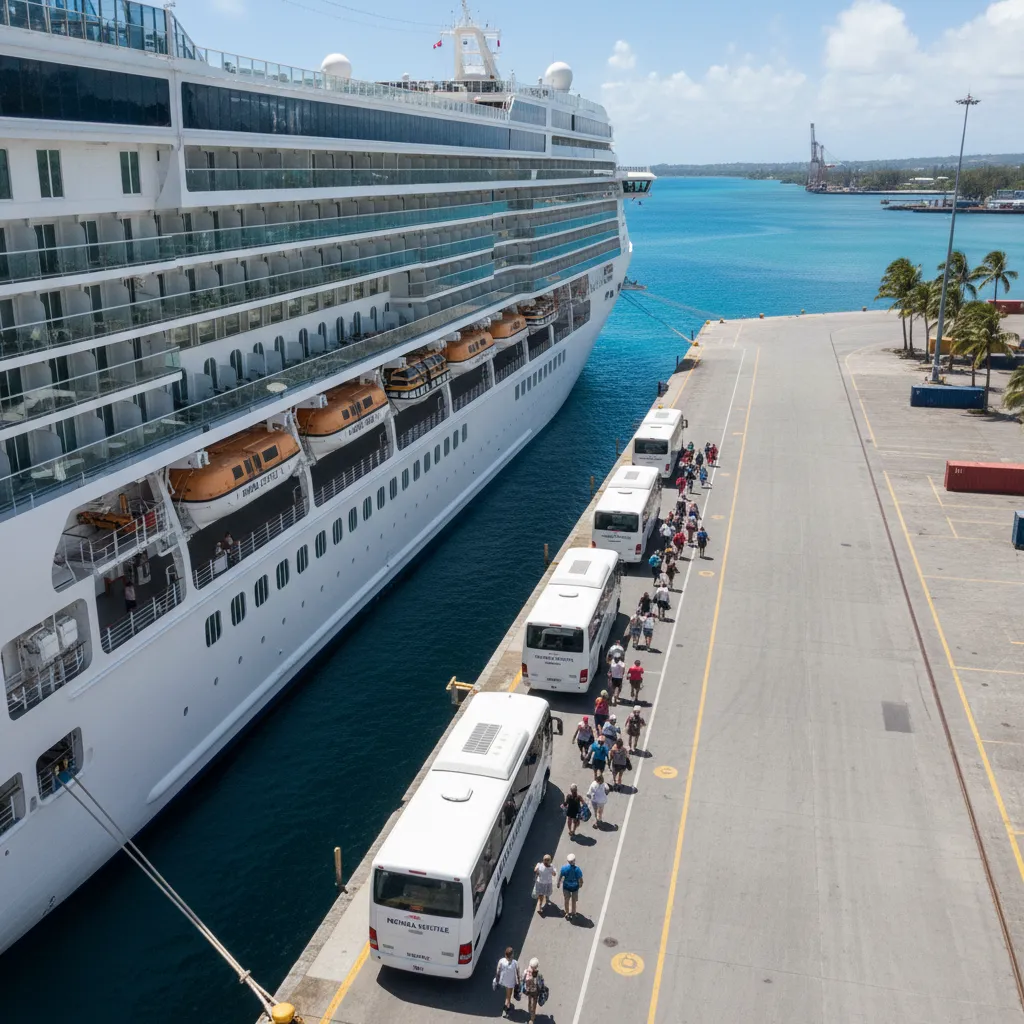
The history of the Isle of Pines penal colony centers on its use as a French correctional facility between 1872 and 1912. Established in New Caledonia, it primarily housed political exiles from the Paris Commune (Communards) and convicted criminals. Known as an “open-air prison,” it left behind significant ruins near Kuto Bay that serve as a poignant memorial to colonial deportation.
The Origins of French Deportation in the Pacific
To fully understand the history of the Isle of Pines penal colony, one must look back to 19th-century France. Following the lead of the British in Australia, the French government sought a solution for its overflowing prisons and a strategy to colonise its antipodean territories. New Caledonia, annexed by France in 1853, was selected as the destination for the bagne (penal colony).
While the main island, Grande Terre, hosted the administrative centre of the penal system at Nouville (Nou Island), the Isle of Pines (Île des Pins) was designated for a specific class of prisoners. The geography of the island—isolated by miles of ocean yet self-contained—made it a natural fortress. For the French administration, it was the perfect location to segregate different categories of detainees, keeping the most dangerous or politically influential away from the nascent colonial society in Nouméa.

The Communards: Political Exiles in Paradise
The defining chapter of the Isle of Pines’ history began in 1872 with the arrival of the Communards. These were not common criminals, but political revolutionaries who had participated in the Paris Commune of 1871—a radical socialist government that briefly ruled Paris. Following the bloody suppression of the Commune, thousands were sentenced to deportation.
Life as a Political Deportee
Unlike the convicts sentenced to hard labour on Grande Terre, the political deportees on the Isle of Pines were granted a unique status. They were considered “simple deportees” rather than convicts. This distinction meant they were not forced to wear prison uniforms, nor were they subjected to the brutal forced labour gangs that characterised the horrors of the main penal settlements.
Instead, they lived in what was effectively an open-air prison. They built their own huts, cultivated gardens, and formed a microcosm of Parisian society in the tropics. They organised theatre performances, debates, and published journals. However, despite the physical beauty of their surroundings—often described as the “Jewel of the Pacific”—the psychological toll of exile was immense. They were thousands of kilometres from home, separated from their families, and trapped on an island with no hope of escape.
Visiting the Ruins near Kuto Bay
For modern travellers, particularly those visiting from New Zealand, the ruins of the penal colony offer a stark contrast to the resort atmosphere of the island. The primary site is located just a short walk from the Kuto ferry wharf, making it easily accessible for day-trippers and long-stay visitors alike.
The ruins are overgrown with vegetation, creating a haunting atmosphere where nature is slowly reclaiming the stone. The walls of the prison enclosure are still visible, built from local coral and limestone. Visitors can walk through the roofless shells of the administrative buildings and the communal cells.
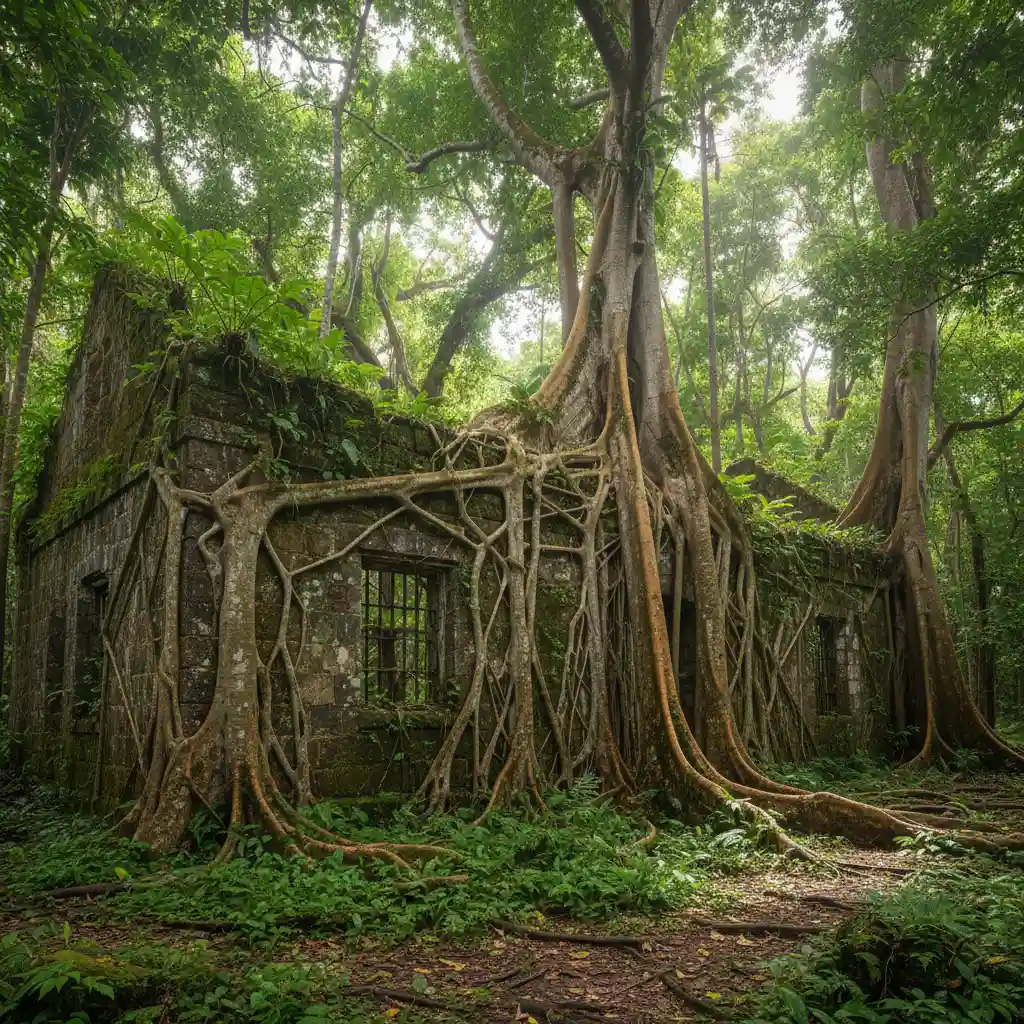
What remains of the prison complex?
The site near Kuto was the administrative hub for the 5th Commune. Key structures that remain identifiable include:
- The Perimeter Walls: High stone walls that once separated the prisoners from the free settlers and the indigenous Kunie population.
- The Guards’ Quarters: Smaller stone buildings where the military personnel lived.
- The Bakery and Kitchens: Essential infrastructure for feeding the thousands of exiles stationed there.
Walking through these arches, one can sense the eerie silence that has replaced the bustle of the 3,000 deportees who once inhabited this space.
The Water Tower: A Monument to Forced Labour
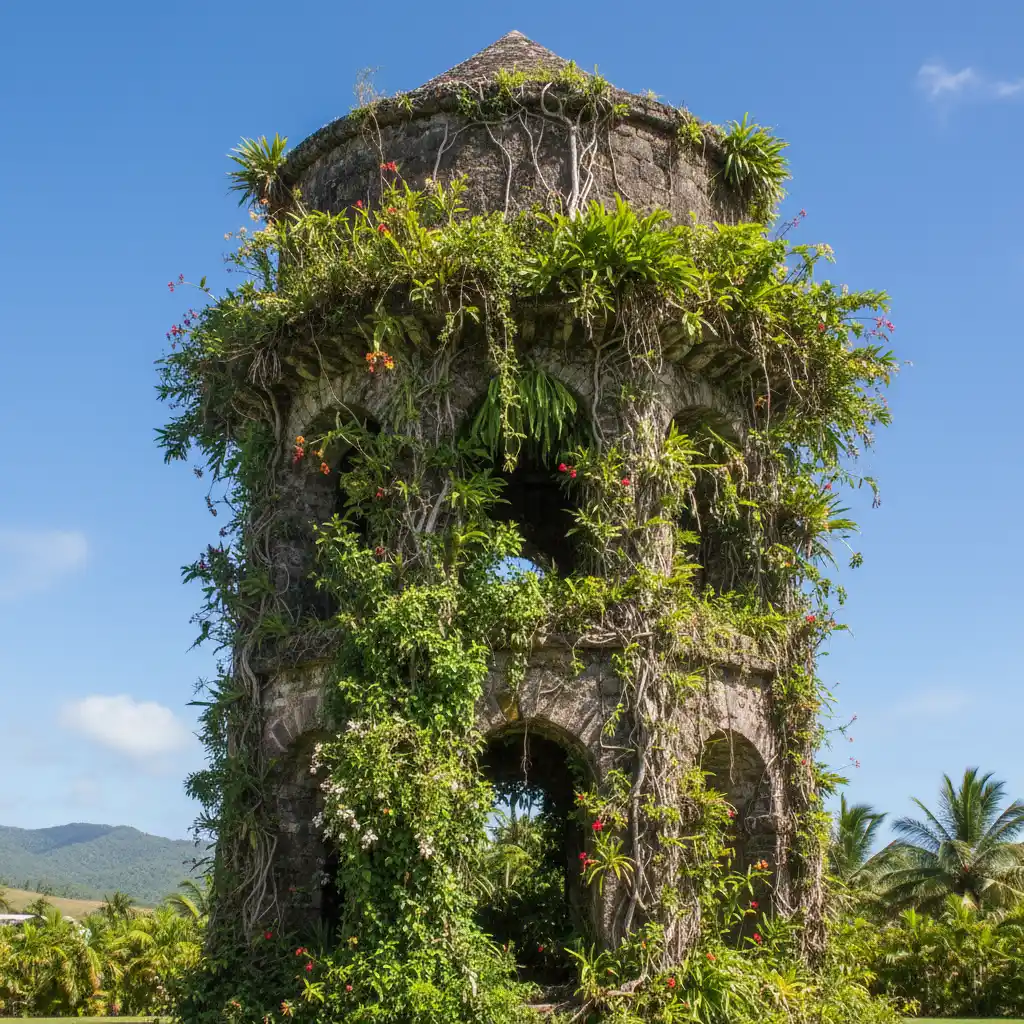
While the political prisoners were exempt from the hardest labour, common law convicts (transported criminals) were also sent to the Isle of Pines to build infrastructure. The most impressive surviving example of this is the Water Tower (Château d’Eau), located in Ouro.
Constructed in 1874/1875, this structure was an engineering feat for its time and location. It was designed to collect and distribute fresh water to the penal settlement. The tower stands as a testament to the backbreaking work of the convicts who quarried the stone by hand and erected the structure without modern machinery. Today, it remains one of the best-preserved historical monuments on the island, covered in creeping vines but structurally sound.
The Cemetery of the Deported
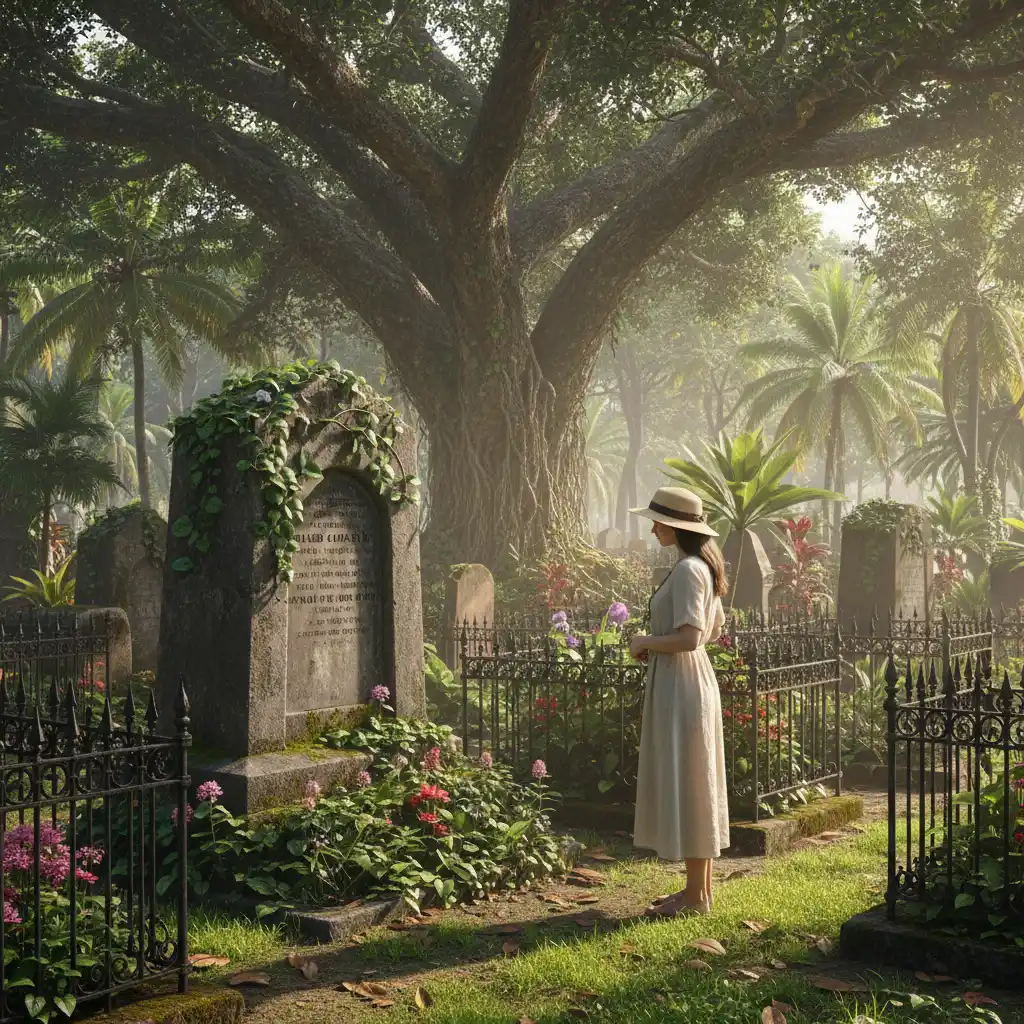
A short distance from the main ruins lies the Cimetière des Déportés (Cemetery of the Deported). This is perhaps the most moving site on the Isle of Pines. It serves as the final resting place for hundreds of Communards and convicts who died of disease, malnutrition, or despair before the amnesty of 1880 allowed the survivors to return to France.
The cemetery is distinct for its lack of religious symbols on many graves, reflecting the secular and often anti-clerical views of the socialist Communards. Instead of crosses, many headstones feature political inscriptions or simple triangles. The site is well-maintained and offers a quiet place for reflection on the human cost of the French judicial system in the Pacific.
Respecting the Historical Site and Local Culture
When visiting the penal colony ruins, it is vital to remember that the Isle of Pines is not just a tourist destination; it is the ancestral home of the Kunie people. The relationship between the indigenous population and the penal colony was complex. The local tribes were often displaced or forced to coexist with the influx of thousands of French prisoners.
Guidelines for Responsible Visitation
For New Zealand tourists accustomed to the strict heritage protections of the Department of Conservation (DOC), the ruins on Isle of Pines may appear surprisingly accessible and unfenced. However, respectful behaviour is mandatory:
- Do not climb on the walls: The masonry is old and unstable in places. Climbing damages the heritage and poses a safety risk.
- Leave artifacts in place: You may find shards of pottery, glass, or metal on the ground. These are historical artifacts and must not be removed as souvenirs.
- Dress modestly: While Kuto is a beach area, when entering the cemetery or the village areas near the ruins, covering up swimwear is a sign of respect to the local community.
Practical Information for New Zealand Travellers
The Isle of Pines (L’Île des Pins) is a favourite extension for Kiwis visiting Nouméa. Here is how to incorporate the history of the penal colony into your itinerary.
Getting There
The ruins are located in Kuto, which is the primary arrival point for the Betico 2 ferry. The ferry ride from Nouméa takes approximately 2.5 hours. Alternatively, Air Calédonie offers a short 20-minute flight from Nouméa-Magenta airport to the island’s airfield, which is a short transfer from Kuto.
Best Time to Visit
The ruins are open year-round and are free to access. The best time to explore is in the early morning or late afternoon to avoid the midday tropical heat. For photography enthusiasts, the “Golden Hour” just before sunset casts long shadows through the prison arches, emphasizing the texture of the ancient coral stone.
Understanding the history of the Isle of Pines penal colony adds a profound layer of depth to a New Caledonia holiday. Beyond the white sands and turquoise lagoons, the crumbling walls of Kuto tell a story of revolution, exile, and resilience that links the Pacific to the turbulent history of Europe.
Frequently Asked Questions
When was the Isle of Pines penal colony closed?
The penal colony on the Isle of Pines effectively ceased operations as a depot for political prisoners after the amnesty of 1880, which allowed the Communards to return to France. However, the administration of the penal system in New Caledonia continued until the transportation of convicts officially ended in 1897, and the system was fully abolished in 1912.
Who were the Communards imprisoned on the Isle of Pines?
The Communards were members and supporters of the Paris Commune, a radical socialist revolutionary government that ruled Paris from March to May 1871. After the French Army defeated the Commune, thousands were arrested and deported to New Caledonia. Notable figures included journalist Henri Rochefort and anarchist Louise Michel (though Michel was held near Nouméa before being transferred).
Is there an entrance fee to visit the Kuto ruins?
No, there is currently no entrance fee to visit the penal colony ruins near Kuto Bay. It is an open-access historical site. However, visitors are encouraged to treat the area with respect and may choose to hire a local guide to gain deeper insights into the history.
Can you walk from the ferry to the penal colony ruins?
Yes, the ruins are very close to the ferry wharf at Kuto Bay. It is a short and easy walk, taking only a few minutes. This makes it an ideal activity for day-trippers arriving on the Betico ferry who want to see some history before heading to the beach.
Why is it called the Isle of Pines?
The island was named by Captain James Cook in 1774. As he sailed past, he observed the tall, columnar pine trees (Araucaria columnaris) that line the coast and ridges of the island. These endemic pines are distinct from the coconut palms usually associated with the Pacific and remain a symbol of the island today.
What is the difference between the Isle of Pines prison and Nou Island prison?
The prison on Nou Island (Nouville) near Nouméa was the administrative headquarters and housed “hard labour” convicts who faced brutal conditions and chain gangs. The Isle of Pines was primarily reserved for political deportees (Communards) who had more freedom of movement, did not wear uniforms, and were not subjected to forced hard labour, although they were still exiled.