
Special assistance flights NZ refers to the personalized support services provided by airlines and airports in New Zealand for passengers with disabilities, reduced mobility, or medical conditions. These services include wheelchair support, priority boarding, and specialized care for sensory or cognitive needs, ensuring all travelers can fly safely and comfortably across the country.
How to Request Wheelchair Assistance for Flights in New Zealand?
Requesting wheelchair assistance is one of the most common requirements for special assistance flights NZ. Airlines like Air New Zealand and Jetstar provide comprehensive support, but it is essential to notify the carrier at least 48 hours before departure. This ensures that the necessary equipment and personnel are available to facilitate a smooth transition from the check-in counter to the aircraft seat. When booking, you will encounter specific industry codes that help the airline understand the level of support you require.
Understanding Wheelchair Service Codes (WCHR, WCHS, WCHC)
To provide the correct level of care, the aviation industry uses three primary classifications for wheelchair assistance. WCHR (Wheelchair Ramp) is for passengers who can negotiate stairs and walk to their seat but require assistance for long distances within the terminal. WCHS (Wheelchair Steps) is for those who cannot negotiate stairs but are able to walk to their seat once inside the aircraft. Finally, WCHC (Wheelchair Cabin) is for passengers who are completely immobile and require a specialized aisle chair and staff assistance to be transferred directly into their seat. Providing the correct code during the booking process prevents delays and ensures that the right lifting equipment is on standby.
Traveling with Your Own Mobility Aid
If you are traveling with your own wheelchair, whether manual or electric, you must provide the airline with its dimensions, weight, and battery type. New Zealand aviation safety regulations are particularly strict regarding battery-powered devices. Manual wheelchairs are generally carried free of charge in addition to your standard baggage allowance. For electric wheelchairs, you must specify if the battery is a non-spillable (dry cell), spillable (wet cell), or lithium-ion variety. Lithium-ion batteries often have specific Watt-hour (Wh) limits, typically capped at 300Wh for a single battery or 160Wh each for two batteries, depending on the airline’s policy and the Civil Aviation Authority (CAA) guidelines.

Battery Safety and Dangerous Goods Regulations
Handling electric mobility aids requires compliance with dangerous goods regulations. Passengers are often required to insulate the battery terminals to prevent short circuits and, in some cases, remove the battery and carry it in the cabin. It is highly recommended to bring the manufacturer’s user manual or a technical data sheet to the airport to assist ground staff in safely securing the device. In New Zealand, the Aviation Security Service (AvSec) will inspect all mobility aids at the security screening point, so arriving early—at least three hours before an international flight and two hours before a domestic flight—is vital.
Flying with Medical Conditions: Requirements and Clearances
Flying with a medical condition requires careful planning to ensure the safety of both the passenger and the flight crew. For many conditions, airlines require a formal medical clearance to confirm that the individual is ‘fit to fly.’ This is especially true for special assistance flights NZ where regional routes may use smaller aircraft with limited onboard medical facilities. The primary document used for this purpose is the Medical Information Form, commonly known as a MEDA form.
The MEDA (Medical Fitness for Air Travel) Form
A MEDA form must be completed by the passenger’s treating physician and submitted to the airline’s medical unit, usually 3 to 5 days before the flight. Conditions that typically require a MEDA form include recent major surgery, unstable cardiovascular conditions, late-stage pregnancy, or infectious diseases that could pose a risk to other passengers. The airline’s medical team will review the information to determine if any special arrangements, such as onboard oxygen or a medical escort, are necessary. If the condition is chronic and stable, some airlines offer a Frequent Traveller Medical Card (FREMEC) which simplifies the process for future bookings.
Managing Medications and Documentation
When flying within or from New Zealand, it is crucial to carry all essential medications in your carry-on luggage rather than checked bags. This ensures access during the flight and protects the medication from the extreme temperature fluctuations in the cargo hold. Always carry a copy of your prescription and a letter from your doctor explaining the necessity of the medication, especially if you are carrying needles, syringes, or large volumes of liquid medication (over 100ml). For international travel, this documentation is essential for clearing customs and explaining the presence of controlled substances to border authorities.

Traveling After Surgery or Major Illness
Air travel places unique stresses on the body, including reduced air pressure and lower oxygen levels. For those recovering from surgery, the risk of Deep Vein Thrombosis (DVT) or complications from trapped gases (such as after abdominal or eye surgery) is elevated. New Zealand airlines generally follow the guidelines set by the Aerospace Medical Association. For example, most carriers require a waiting period of at least 24 hours after minor laparoscopic surgery and up to 10 days after major chest or abdominal surgery. Always consult your surgeon before booking special assistance flights NZ to ensure the timing of your journey is safe.
Service Dog Policies for New Zealand Aviation
New Zealand has a very clear legal framework regarding the transport of service dogs. Unlike some other jurisdictions, NZ airlines generally only recognize ‘Certified Assistance Dogs’ that have been trained by organizations affiliated with Assistance Dogs International (ADI) or the International Guide Dog Federation (IGDF). This includes guide dogs for the blind, hearing dogs, and mobility assistance dogs.
Definition of a Certified Assistance Dog
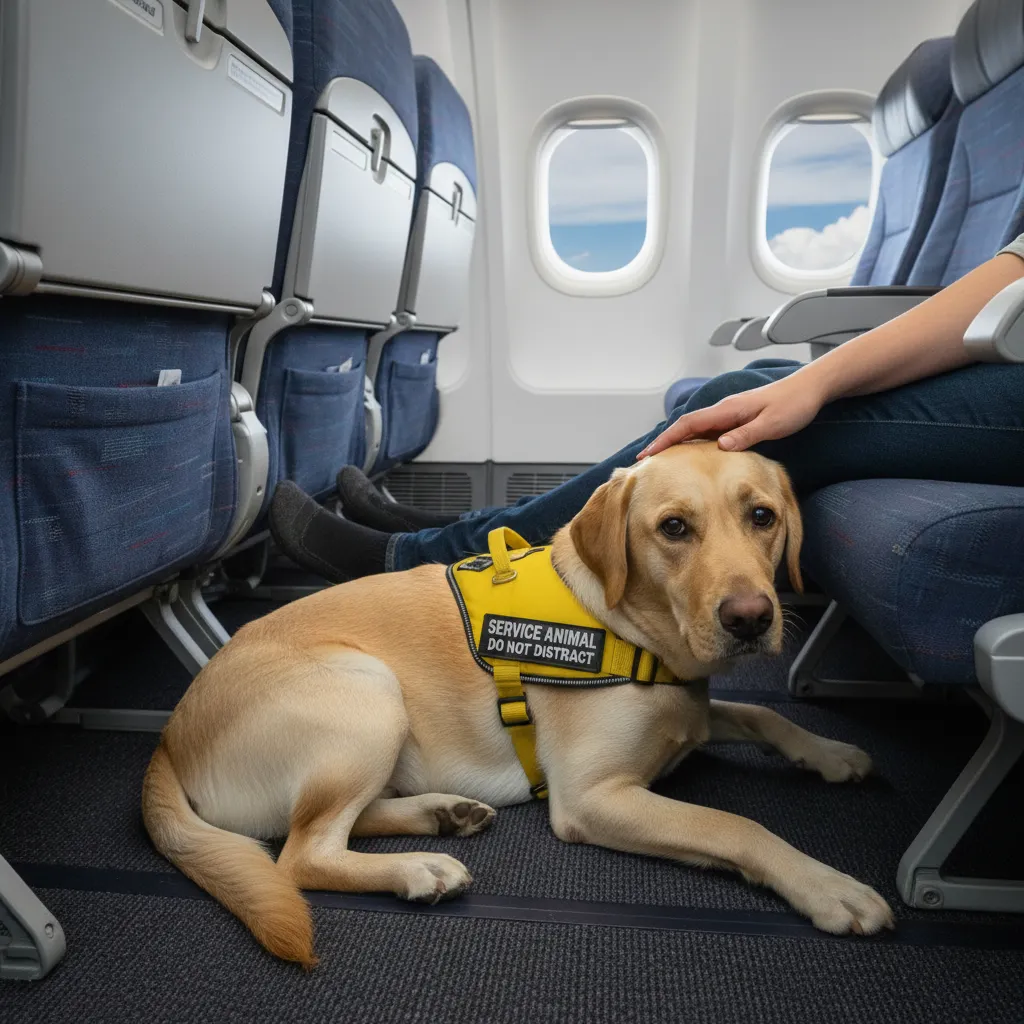
To qualify for travel in the aircraft cabin, a service dog must be specifically trained to perform tasks for a person with a disability and must behave appropriately in a public setting. In New Zealand, ‘Emotional Support Animals’ (ESAs) are typically not granted the same cabin access rights as certified assistance dogs and must usually travel in the cargo hold as pets. This distinction is important for travelers to understand before booking, as documentation proving the dog’s certification and its current vaccination status will be required by the airline’s accessibility team.
Booking and Documentation for Service Animals
When booking special assistance flights NZ with a service dog, you must notify the airline well in advance. For domestic flights, this is relatively straightforward, but for international flights, the requirements are much more complex due to New Zealand’s strict biosecurity laws. The Ministry for Primary Industries (MPI) regulates the entry of all animals to protect the country from diseases like rabies. Travelers must ensure they have the correct import permits and veterinary certificates. On the aircraft, the dog is typically seated on the floor at the passenger’s feet, and the airline will often block out the adjacent seat at no extra cost to provide the dog with enough space to lie down comfortably.
Oxygen Availability and Respiratory Support Onboard
For passengers with respiratory conditions such as COPD or cystic fibrosis, maintaining adequate oxygen levels during a flight is a primary concern. The pressurized cabin of a commercial aircraft usually simulates an altitude of 6,000 to 8,000 feet, which results in lower oxygen saturation in the blood. Special assistance flights NZ offer two main solutions: the use of a Portable Oxygen Concentrator (POC) or airline-supplied supplementary oxygen.
Using Portable Oxygen Concentrators (POCs)
Most modern airlines allow passengers to bring their own POC, provided it is an FAA-approved model. The device must be battery-operated, as aircraft power outlets cannot be guaranteed to work or provide sufficient wattage for medical devices. A critical requirement is the battery life; passengers must carry enough battery power to last 150% of the total flight duration to account for potential delays. Like other medical equipment, the POC must be declared during the booking process, and a medical certificate must be provided stating the flow rate required and the passenger’s ability to operate the device.
Airline-Supplied Supplementary Oxygen
If you do not own a POC, some airlines can provide supplementary oxygen for a fee. This service is typically only available on international flights and must be requested at least 48 to 72 hours in advance. The airline will provide a cylinder with a regulated flow rate (usually 2 or 4 liters per minute). It is important to note that airline-supplied oxygen is generally only for use during the flight and cannot be used inside the airport terminal. Passengers must arrange their own oxygen supply for the time spent on the ground before boarding and after landing.

Sensory and Cognitive Accessibility: The Sunflower Lanyard
Accessibility is not limited to physical mobility. Many passengers traveling on special assistance flights NZ have ‘hidden disabilities,’ such as autism, dementia, or anxiety disorders. New Zealand’s major airports—Auckland, Wellington, Christchurch, and Queenstown—have adopted the Hidden Disabilities Sunflower Lanyard program. This lanyard is a discreet way for passengers to signal to airport staff that they may need extra time, clear instructions, or a quieter environment.
Navigating Sensory Overload in NZ Terminals
Airports are high-sensory environments with loud announcements, bright lights, and large crowds. To assist passengers with sensory sensitivities, some New Zealand airports now offer ‘quiet rooms’ or low-sensory zones. Auckland Airport, for example, provides a detailed sensory map to help travelers identify areas that might be overwhelming. When requesting special assistance, you can also ask for priority boarding, which allows you to settle into the aircraft before the main group of passengers, reducing the stress of the boarding process.
Your Rights: The Civil Aviation Authority (CAA) Guidelines
In New Zealand, the rights of passengers with disabilities are protected under the Human Rights Act and specific Civil Aviation Rules. Airlines are required to provide assistance to ensure that disabled passengers have equal access to air travel, provided that safety is not compromised. This includes the right to be treated with dignity, the right to have mobility equipment handled with care, and the right to receive clear information about safety procedures in an accessible format. If you feel that your needs were not met, you have the right to lodge a formal complaint with the airline or the New Zealand Commerce Commission.
Do I have to pay for wheelchair assistance in NZ?
No, wheelchair assistance is provided free of charge by all major airlines operating in New Zealand, including domestic and international routes. However, it is recommended to book this service at least 48 hours in advance to ensure availability and proper staffing.
Can I bring my own oxygen on a flight?
Yes, you can bring your own Portable Oxygen Concentrator (POC) if it is an FAA-approved model. You must provide a medical certificate and ensure you have enough battery life for 150% of the flight duration. Compressed oxygen tanks are generally prohibited as carry-on or checked baggage.
How far in advance should I request special assistance?
Most airlines require at least 48 hours’ notice for special assistance requests, such as wheelchair support, medical clearance, or service dog travel. For complex needs like onboard oxygen or stretcher cases, 72 hours or more may be required.
Are emotional support animals allowed on NZ flights?
Generally, no. New Zealand airlines typically only allow certified assistance dogs (trained by ADI or IGDF recognized organizations) in the cabin. Emotional support animals are usually required to travel in the cargo hold according to standard pet transport policies.
What is a MEDA form?
A MEDA (Medical Information Form) is a document completed by your doctor that informs the airline about your medical condition. It allows the airline’s medical team to assess your fitness to fly and determine if any special equipment or precautions are needed for your safety.
How do I navigate Auckland Airport with a disability?
Auckland Airport offers various facilities including accessible parking, toilets, and the Sunflower Lanyard program for hidden disabilities. You can also request a ‘meet and assist’ service where staff will guide you through check-in, security, and to your gate.